Chimney flashing is the layered metal that seals the joint between your chimney and the roof. Repair means resealing, reshaping or replacing the damaged pieces so water runs over the joint instead of into it. It is one of the most common causes of ceiling stains near a fireplace wall, and it is a core part of roof flashing repair in Folsom.
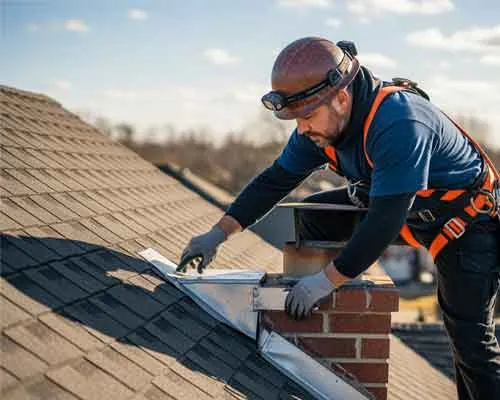
What chimney flashing repair involves
A chimney punches straight through the roof, so it needs four separate flashing details: an apron on the downhill face, step flashing along the sides, a saddle or cricket on the uphill side, and counter flashing that laps over the top of the base pieces. If any one of them fails, rain finds the gap. The most common culprit is not the metal itself but the sealant someone used to patch it.
Counter flashing is usually tucked into a cut groove (a reglet) in the masonry mortar, or fastened to a stucco-clad chimney. Mortar erodes, caulk dries and shrinks, and the metal lifts. A repair therefore often means more than a dab of sealant: the provider may re-cut the groove, install new counter flashing and re-tie the step flashing back into the shingle courses.
Common problems this repair solves
- Cracked or shrunken caulk along the top edge of the metal
- Rusted or pinholed base flashing on the downhill face
- Counter flashing that has pulled out of eroded mortar joints
- No cricket behind a wide chimney, so water and debris dam up uphill
- Step flashing nailed or sealed face-down instead of woven into the shingles
Signs you may need chimney flashing repair
- Brown ceiling or wall stains near the fireplace or chimney chase
- Dripping inside the firebox or damp smell after rain
- Visible gaps, bent metal or rust streaks at the chimney base
- Missing or crumbling mortar at the top of the metal
- Granules and debris piling up behind the chimney
How the repair process works
- Inspect. The provider checks the chimney perimeter, the flashing layers, the mortar and the attic side of the roof deck for moisture.
- Diagnose. They separate a flashing failure from a cracked crown, failing masonry or condensation, since each needs a different fix.
- Repair or rebuild. Damaged metal is replaced, counter flashing is re-set into clean joints, and a cricket is added where the chimney is wide.
- Seal and test. Joints are sealed only where metal-to-masonry movement is expected, and the area is checked for water entry.
What a good repair achieves
- Stops water from running down the chimney chase into ceilings
- Protects roof sheathing and rafters beside the chimney
- Often avoids a larger repair if caught while the masonry is still sound
Brick, stone or stucco: how the chimney material changes the repair
The chimney's outer material decides how counter flashing is attached, so a repair that works on brick can fail on stucco. On a brick chimney, the roofer usually cuts a shallow groove along a mortar joint, tucks the top edge of the metal into it and re-fills the joint. On a stone-veneer chimney, the veneer often hides the real structure behind it, so the flashing may need to be woven into the water barrier behind the stone rather than simply pressed against the face.
A stucco-clad chimney chase, common on framed fireplaces, relies on the metal tucking behind the stucco or under a termination bar, and hairline stucco cracks above the metal can feed water straight behind it. A metal-flue chimney with a round pipe is different again: it uses a cone-shaped base with a storm collar around the pipe. Tell the roofer which type you have, or send a ground-level photo, and the quote will be more accurate.
Why a cricket matters on a wide chimney
On the uphill side of a chimney, water running down the roof hits a flat wall of brick and stops. Without a cricket (a small peaked saddle behind the chimney) the water, along with leaves and grit, pools there and works into every joint it can find. Building codes commonly call for a cricket once a chimney passes a certain width, with the model residential code using a threshold of about 30 inches measured across the slope.
If your chimney is wide and the upper side shows stains, rust, or a permanent line of debris, ask whether a cricket is present and properly flashed. Adding one is often the difference between a repair that lasts and one that returns every winter.
Chimney leak or something else? How to tell the difference
Not every drip near a fireplace is a flashing failure. Use this as a rough guide, then let a roofer confirm.
| What you see | Most likely cause |
|---|---|
| Stain on the ceiling beside the chimney chase, only after rain | Base or step flashing, or counter flashing separated from the masonry |
| Water or rust marks inside the firebox | Cracked chimney crown, missing cap or open flue, not usually flashing |
| Damp patch high on the chase wall in an upstairs room | Counter flashing or stucco crack above the roof line |
| Moisture on the glass or sooty drips with no rain | Flue condensation or an exhaust issue |
| Stain that appears in dry weather | Plumbing, HVAC condensation or humidity, not a roof leak |
While you wait for a visit, take photos of the stain with a ruler or coin for scale, note which storms trigger it, and keep any furniture or electronics clear of the area. Do not climb up to caulk the chimney yourself.
Questions to ask before a chimney flashing repair
- Will you replace the counter flashing, or only seal it?
- Is a cricket needed on this chimney, and how will it be flashed?
- How will you handle the mortar joints or stucco above the metal?
- What metal will you use, and does it suit my chimney and roof?
- What exactly is covered by the warranty on the repair, and in writing?
Chimney Flashing Repair in Folsom: local considerations
Folsom homes use brick, stone-veneer and stucco-clad chimneys, and each wants slightly different counter flashing details. The dry summers bake sealant and the wet winters test every joint, so patches applied in fall often fail by the next rainy season. Homeowners in Empire Ranch and Broadstone regularly ask about this after the first heavy storm.
If a leak shows up elsewhere on the roof as well, a provider may also look at roof flashing leak repair for the other penetrations. You can see the full list of what we cover on the Folsom roof flashing repair homepage.
Cost considerations
The cost of chimney flashing repair depends on chimney width, whether a cricket is needed, the masonry condition, roof pitch and access. A resealing job is a small repair; rebuilding all four flashing layers on a wide chimney is a bigger one. Prices vary with the job, so ask for a written scope before work starts.
Be cautious of any quote that is only 'caulk the chimney'. Sealant alone rarely lasts, and a repair that ignores the counter flashing often leaks again.
When to call a professional
Call as soon as you see a stain near the chimney. Roof work at a chimney involves ladders, steep pitches and masonry, so this is not a safe DIY repair, and leaving it can soak insulation and framing.
Chimney Flashing Repair FAQs
Can chimney flashing be repaired, or does it have to be replaced?
If the metal is sound and only the sealant or mortar joints have failed, a repair can be enough. Heavily rusted, bent or missing flashing is usually replaced piece by piece.
Why does my chimney leak only in heavy rain?
Wind-driven rain pushes water sideways into small gaps in the counter flashing or mortar that stay dry in light rain.
Is a leak at the chimney always the flashing?
No. A cracked crown, failing bricks or a missing cap can also let water in. A good provider checks all of them.